

 русский
 Español
 عربى
عربى

Manufacturers have several ways to make a plastic component that needs more than one material or part. One common method is to mold separate pieces and join them later with screws, clips, adhesives, welding, or another assembly process. 2K Moulding takes a different approach. Two materials, or sometimes two colors of the same material, are molded into one component during a coordinated injection process.
For OEMs, product engineers, and purchasing teams, the question isn't simply whether two-material injection is more advanced. What matters is whether it actually suits the product, materials, production volume, and performance requirements.
In the right application, 2K molding can cut assembly work, combine several functions into one part, and make production more consistent. But traditional assembly can still make more sense when products change often, need individual replacement, or are produced in smaller quantities.
The useful comparison is therefore not about which process sounds better. It is about which one fits the actual job.
What Is 2K Moulding and How Does It Work?
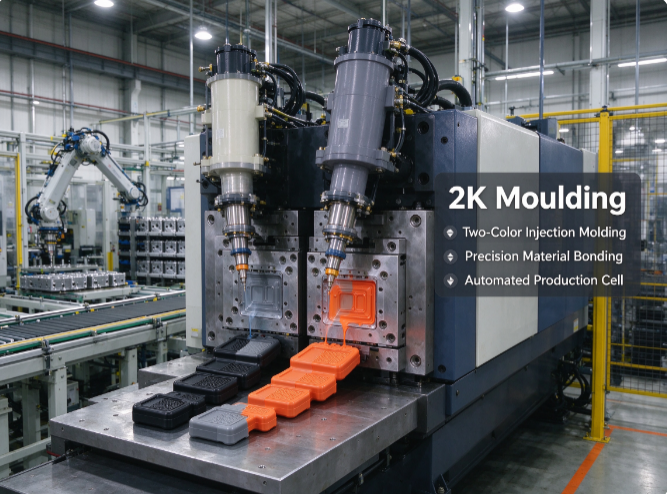
2K molding, also called two-component or two-shot injection molding, creates a component from two materials or material formulations during one coordinated molding process.
The first material is injected into the mold to form the initial section. Depending on the machine and mold setup, the mold can then rotate, transfer, or reposition the molded section before the second material is injected.
The second material is then molded onto, around, or against the first section. The two parts become one finished component.
Common combinations include:
- Rigid plastic with a soft elastomer
- Two different plastic grades
- Two colors for identification or appearance
- Structural plastic with a sealing material
- A hard body with a flexible grip
The actual process depends on the machine, mold construction, material compatibility, and shape of the part.
How Traditional Assembly Produces a Multi-Component Product
With traditional production, separate components are normally molded first and joined later.
Depending on the product, manufacturers may use screws, clips, snap-fits, adhesives, heat staking, ultrasonic welding, or mechanical pressing. Each component can be produced and adjusted on its own.
That flexibility can be useful. If an engineer needs to change a cover, for example, there may be no need to redesign the entire product.
The downside is pretty straightforward: more separate parts usually mean more handling and more production steps. Every joining operation also creates another point where alignment, fit, or assembly quality can vary.
Key Differences Between 2K Moulding and Traditional Assembly
Both methods can produce multi-material or multi-part products, but the production approach is quite different.
| Factor | 2K Moulding | Traditional Assembly |
|---|---|---|
| Production stages | Often fewer | Usually more |
| Part integration | High | Depends on joining method |
| Assembly labor | Can be reduced | Usually required |
| Material combination | Integrated during molding | Joined afterward |
| Design changes | May require mold changes | Often easier by component |
| Tooling investment | Can be higher | May be spread across parts |
| Appearance | Highly integrated | Depends on assembly accuracy |
| Production volume | Often medium to high | Suitable for many volumes |
| Automation | High potential | Also possible |
These are general differences, not fixed rules. Tooling cost, cycle time, labor rates, part geometry, and production volume can change the calculation quite a bit.
When 2K Moulding Makes Sense for Multi-Material Parts
Two-material injection is useful when each material has a clear job.
A common example is a rigid plastic housing with a soft elastomer grip. The rigid section provides structure, while the softer material gives the user a better contact surface.
Integrated sealing is another example. An elastomer can be molded directly onto a rigid component to create a sealing area, reducing the need to install a separate gasket.
Other applications include:
Automotive components: Rigid plastics combined with soft-touch areas or seals.
Consumer electronics: Housings with soft-touch sections, buttons, or protective features.
Medical and laboratory products: Components using controlled material combinations where compatibility and required validation have been established.
Industrial controls: Housings combined with buttons, seals, or identification features.
The key is having a real reason to use two materials. If the second material doesn't add a useful function, the extra mold complexity may not be worth it.
Reducing Assembly Steps Can Be a Major Advantage
One reason manufacturers look at 2K Moulding is the chance to combine several production steps.
Imagine a product that normally needs three molded parts followed by several assembly operations. A two-shot design may bring some of those functions together in one molded component.
This can reduce:
- Manual handling
- Component counting
- Fastener use
- Adhesive application
- Alignment work
- Intermediate inventory
- Potential assembly mistakes
That sounds attractive, but fewer assembly steps don't automatically mean a lower total cost.
A two-shot mold can be expensive and may require specialized equipment and tighter process control. The economics usually become more interesting when production volume is high enough to spread those development and tooling costs over many parts.
Product Appearance Can Benefit From Two-Material Injection
Appearance is another reason to consider two-shot molding.
Manufacturers can create defined color areas, soft-touch surfaces, or integrated visual features during the molding process. The finished part may have fewer visible joints than a product made from separately assembled components.
This can matter for products where appearance and feel are part of the purchasing decision.
Still, cosmetic quality doesn't happen automatically. Gate position, material flow, cooling, shrinkage, and mold surface finish all affect the final part.
For B2B buyers, approving actual samples before mass production is a practical step. A drawing may look fine, but the molded part tells you much more.
Two-Material Injection Can Improve Part Integration
With traditional assembly, there is usually a physical interface between separately produced components. That interface may depend on screws, clips, adhesive, or another joining method.
In a properly designed 2K component, the second material is molded onto or around the first material during production.
Take a sealing application as an example. Instead of producing a separate gasket and installing it later, the sealing material can be molded directly onto the rigid housing.
The connection can rely on chemical adhesion, mechanical interlocking, or both. The right approach depends on the materials and geometry.
Engineers still need to test the connection under real conditions, including temperature, humidity, chemicals, and repeated movement where applicable.
Material Compatibility Is One of the Biggest Technical Issues
Two-shot molding doesn't mean that any two plastics can simply be put into the same mold.
The materials need to work with the molding process and, when required, bond properly with each other.
Important factors include:
- Melt temperature
- Shrinkage
- Adhesion
- Chemical compatibility
- Thermal expansion
- Hardness
- Moisture sensitivity
- Processing window
Some combinations bond well. Others may need special geometry to create a mechanical lock.
This is where practical testing matters. Material datasheets are useful, but mold trials can show what actually happens with the selected combination.
Traditional Assembly Can Be Better for Products With Frequent Design Changes
2K molding uses specialized tooling, and complex molds can represent a significant investment.
If a product is still changing regularly, traditional assembly may provide more freedom. An engineer might be able to revise a cover, seal, or frame without rebuilding the whole molding system.
This is common with products whose internal electronics or mechanical structure are still being developed.
Once a two-shot mold is built around a particular geometry, major design changes can require mold modification or even new tooling.
So 2K molding can still work for development projects, but tooling plans should be discussed early.
Production Volume Has a Strong Influence on the Business Case
Production volume can change the economics considerably.
For smaller quantities, traditional molding and assembly may be easier to justify because tooling and development costs can remain more manageable.
At higher volumes, automation and reduced assembly work can make two-shot molding more attractive.
| Production situation | Often worth evaluating |
|---|---|
| Prototype or small quantity | Conventional molding and assembly |
| Medium production | Compare both processes |
| High-volume repeat production | Strong case for 2K evaluation |
| Multi-material functional part | 2K is worth investigating |
| Frequent design changes | Separate components offer flexibility |
| Labor-intensive assembly | 2K may reduce process steps |
These are only useful starting points. A proper cost comparison should include tooling, cycle time, labor, scrap, inspection, and maintenance.
How 2K Moulding Can Affect Quality Consistency
Every extra assembly step creates another chance for variation.
A separately installed seal, for example, can be twisted, misplaced, damaged, or left partially assembled. Automated assembly can reduce some of these issues, but it still needs its own controls.
With 2K injection, the second material is positioned by the mold and molding process. When the process is stable, this can make the location and appearance of the second material more consistent.
Quality checks may include:
- Dimensional inspection
- Material verification
- Bond or adhesion testing
- Appearance inspection
- Hardness testing for elastomers
- Functional testing
- Environmental testing
The inspection plan should match the parts that actually matter to product performance.
Geometry Has a Major Role in Two-Shot Molding Feasibility
A part can look simple and still be difficult to mold in two stages.
The design needs to allow proper material flow, cooling, ejection, and accurate positioning between shots.
Important design points include:
Wall thickness: Large differences can lead to uneven cooling and shrinkage.
Draft: Suitable draft helps the part come out of the mold cleanly.
Parting lines: Their position can affect appearance and mold construction.
Mechanical interlocking: This can help when the two materials do not bond strongly on their own.
Gates and runners: These need to support stable filling for each material.
These issues should be reviewed during DFM before tooling starts. Fixing them on a finished mold is a different story.
When Traditional Assembly Still Has Practical Advantages
2K molding has useful advantages, but conventional assembly isn't going away.
It can make sense for products containing replaceable modules or components that need to be serviced separately.
Traditional assembly may also be suitable when:
- Production quantities are relatively low
- Materials are difficult to combine
- Easy disassembly is required
- Design changes happen frequently
- Components come from different suppliers
- Tooling investment needs to stay limited
A machine cover with a replaceable service panel is a simple example. Making everything into one molded component may actually make maintenance harder.
The product's full lifecycle should be considered before choosing the process.
How B2B Buyers Should Compare the Two Processes
A sourcing team should start with the finished product, not the molding machine.
Useful questions include:
- How many components can realistically be combined?
- Does the second material provide a clear function?
- Can the two materials bond reliably?
- What is the expected annual production volume?
- How much assembly labor is currently required?
- How often are engineering changes expected?
- What level of cosmetic consistency is needed?
- What happens if one material needs to change later?
Cost should also be viewed as a complete production calculation.
Two-shot molding may raise the initial tooling cost but reduce recurring assembly work. Traditional assembly may have simpler tooling but higher labor and inventory costs over time.
Prototype Testing Can Clarify the Better Manufacturing Route
Before committing to full production, prototype parts can be made using the proposed process.
For a 2K component, testing can cover material bonding, dimensions, appearance, sealing, and mechanical performance.
The same product requirements can then be checked on an assembled version if traditional production is being considered.
This side-by-side comparison gives engineers and purchasing teams actual information to work with.
It may also uncover issues that were not obvious during design, such as warpage, differential shrinkage, poor adhesion, assembly misalignment, or difficult ejection.
What B2B Buyers Should Ask a 2K Molding Manufacturer
When checking a supplier, don't focus only on machine size or injection tonnage.
Useful questions include:
- Which material combinations can the factory process?
- Can the factory provide mold-flow or DFM analysis?
- What two-shot machine configurations are available?
- How are bonding and mechanical interlocking validated?
- What dimensional tolerances can be maintained?
- How is the second material positioned?
- What quality checks are performed during production?
- Can the process be adjusted for OEM requirements?
For a customized project, production samples are worth requesting before mass manufacturing. They give buyers a chance to check the actual part and not just the proposed process.
Choosing Between 2K Moulding and Traditional Assembly
2K Moulding can be a practical choice when a product genuinely needs two materials or functions in one component. It can reduce assembly work, integrate seals or soft-touch areas, improve positioning consistency, and make sense for repeat production at suitable volumes.
Traditional assembly still has its place. It can be easier to manage when production quantities are low, designs change frequently, components need to be replaced individually, or the materials are difficult to combine in one molding process.
The decision comes down to the product itself: geometry, material compatibility, annual volume, tooling budget, quality needs, and expected product changes. For B2B buyers, comparing the whole manufacturing route—including tooling, labor, inspection, maintenance, and future revisions—gives a much clearer picture of whether two-material injection is actually the right fit.
